Alguns vídeos sobre a Internacional Situacionistas :
Situationist International - part 1
Situationist International - pert 2
Situationist International - part 3
Veja também; Guy Debord - Society of the Spectacle, 1973 pts. 1 - 10

Mostrando postagens com marcador pesquisa. Mostrar todas as postagens
Mostrando postagens com marcador pesquisa. Mostrar todas as postagens
11.7.13


The Many Headed Monster -The audience of contemporary performance - Joshua Sofaer
The Many Headed Monster
The audience of contemporary performance
Joshua Sofaer
Estes recursos tem vindo a ajudar-nos a pensar sobre o papel e as formas possível de participação para o público em relação o evento teatral Labirinto Urbano - Estrategias de se perder que estamos criando.

The Many Headed Monster is an original and inventive resource for anyone interested in contemporary performance practices and their relationships with audiences.
Across a range of artistic disciplines, artists are dealing with audiences in innovative and creative ways, placing the audience at the heart of their work. Contemporary culture is marked by the emancipation of the spectator and the transformation of the audience from passive recipient to active participant. The Many Headed Monster is a critical and practical resource investigating what is at stake for audiences today when they attend a live event.
The Many Headed Monster is a boxed set containing a lecture complete with presentation instructions, extended notes and author’s commentaries, a dvd of 22 performance works by leading UK and international artists, and 50 full colour image cards.
Featured artists include Ian Breakwell and Ron Geesin, Duckie, Blast Theory, Kira O’Reilly, Marina Abramovic and Ulay, Vito Acconci, Bock & Vincenzi, Gob Squad, JJ Xi and Cai Yuan, William Pope.L, Lone Twin, LIGNA, Hermann Nitsch, Coco Fusco and Guillermo Gómez-Peña, Annie Sprinkle, Iain Forsyth and Jane Pollard, Carsten Höller, Yoko Ono, Laura Lima, Luke Jerram, Oreet Ashery and Joshua Sofaer.
Published by Live Art Development
Agency in an edition of 500, 2009
confira o site de Joshua por outras obras dele aqui: Joshua Sofaer
The Future of Ritual - writings on culture and performance - Richard Schechner
The Future of Ritual
Writings on culture and performance
Richard Schechner

"Schechner has given us all the tools we need to appreciate the deeper social significance of what is taking place in front of our eyes instead of accepting it for what it seems to be."
Colin Turnbull, The New York Times
In The Future of Ritual, Richard Schechner explores the nature of ritualised behaviour and its relationships to performance and politics. A brilliant and uncontainable examination of cultural expression and communal action, The Future of Ritual asks pertinent questions about art, theatre, and the changing meaning of "culture" in today's intercultural world. It is richly illustrated with over 50 photos of performances and public events.
The Future of Ritual is a lively, accessible, and timely book which anyone interested in performance, anthropology or Schechner's own work will find fascinating. It is invaluable and compelling reading for student's of performance studies, cultural studies, and theatre anthropology.
Richard Schechner is University Professor at Tisch School of the Arts, New York University. He is editor of TDR: The Journal of Performance Studies, General Editor of the Routledge "Worlds of Performance" series, and artistic director of East Coast Artists. his books include Performance Theory and Between Theater and Anthropology.
Abaixo, você pode encontrar alguns trechos do livro que tem particular relevância para Labirinto Urbano e as pesquisas e os processos envolvidos nossa projeto.
From Chapter 2: Playing
'...the reaction of the non players isa big part of what gives dark play its kick.'
' .....Taken together these examples indicate that dark play:
1 is physically risky;
2 involves intentional confusion or concealment of the frame "this is the play";
3 may continue actions from early childhood;
4 only occasionally demands make believe;
5 plays out alternative selves. The play frame may be so disturbed or disrupted that the players themselves are not sure if they are playing or not - their actions become play retroactively: the events are what they are, but by telling these events, by reperforming them as narratives, they are cast as play. '
'Indeed, art and ritual, especially performance, are the homeground of playing.'
'Playing is a mood, an attitude, a force.'
From Chapter 3:The street is the stage
'What is the relation between "the authorities" and "the people" when the people occupy public streets, squares,plazas and buildings? Do carnivals encourage giddy, drunken, sexy feelings and behaviour - or does the very action of taking spaces, of "liberating" them, make people giddy? Is it accidental that official displays consist of neat rectangles, countable cohorts, marching past and under the fixed gaze of the reviewing stand, while unofficial mass gatherings are vortexes, whirling, full of shifting ups and downs, multi focused events generating tension between large-scale actions and many local dramas? And why is ti that unofficial gatherings elicit, permit, or celebrate the erotic, while official displays are so often associated with the military? Can a single dramaturgy explain political demonstrations, Mardi Gras and similar kinds of carnivals, Spring Break weekends, and ritual dramas?'
These questions are asked of six events selected for their generic range and cultural diversity.
'When people go to the streets en masse, they are celebrating life's fertile possibilities.'
'To allow people to assemble in the streets is always to flirt with the possibility of improvisation - that the unexpected might happen'.
9.7.13
Pistas do método da cartografia - pesquisa-intervenção e produção de subjetividade
Pistas do método da cartografia
pesquisa-intervenção e produção de subjetividade
Orgs.
Eduardo Passos
Virginia Kastrup
Liliana da Escóssia
Pesquisadores que investigam processos nas áreas de saúde, educação, cognição, clinica, grupos e instituições, dentre outros, enfrentam muitas vezes, na escrita de seus projetos, dificuldades em dar conta do item consagrado ao método. Como nomear as estratégias empregadas, quando elas não se enquadram bem no modelo da ciência moderna, que recomenda métodos de representação de objetos preexistentes? O livro apresenta oito pistas do método da cartografia, que se apresenta como uma aposta fecunda frente ao desafio de acompanhar processos, lançando mão de um método igualmente processual. Em lugar de regras e protocolos, as pistas destacam a importância da prática, de ir a campo, lançar-se na água, experimentar disposivista e praticar a escrita, sempre levando em conta a produção coletiva do conhecimento.

The Ludic City - Exploring the potential of public space - Quentin Stevens
Este é o primeiro de uma série de posts sobre livros e artigos que são referencias e, assim, influenciam o nosso trabalho e pesquisa para o projeto Labirinto Urbano.
The Ludic City
Exploring the potential of public spaces
Quentin Stevens
"Why do we have public spaces in cities? What are they for? What role do they have in everyday social life? The Ludic City argues that one of the fundamental functions of public space is as a setting for informal, non-instrumental social interaction, or play. The concept of play highlights the distinctive character of urban experience: the way people sense urban settings, move through them and act within them. Play is an important but largely neglected aspect of people's experience of urban society, and embraces a wide variety of activities which are spontaneous, irrational or risky, and which are often unanticipated by designers, managers and other users. Focusing on the playful uses of public space, this book provides a much-needed counterpoint to the instrumental pragmatism which dominates everyday urban life and the design of city spaces.
Drawing together arguments from the fields of urban design, planning, sociology, anthropology. philosophy and environmental psychology, this book provides afresh and detailed depiction of play in the specific context of urban public space. By illustrating the forms that play takes, it reveals people's creativity, curiosity and imagination in using urban space.
The Ludic City draws upon extensive observation of behaviours in public spaces, with detailed studies of Melbourne, London, Berlin, New York and Brisbane. The finding suggest that even the most typical street corner or innocuous doorway can be a site for risk-taking, the display of identity and testing the limits of one's own abilities.
The book will provide urban designers, policy-makers, planners and researchers with an awareness of how a playful, non-reductive understanding of space and social practice can positively shape urban design practice and public policy."
Quentin Stevens is Lecturer in Planning and Urban Design at the Bartlett School of Planning, University College London. He has a PhD in Urban Design from the University of Melbourne and has studied Architecture and Urban Planning in Melbourne, Berkeley and Chicago. He has also worked as an urban designer and planner in both Australia and the United States and is co-editor of Loose Space: Possibility and Diversity in Urban Life.

Abaixo, você pode encontrar alguns trechos do livro que tem particular relevância para Labirinto Urbano e as pesquisas e os processos envolvidos no projeto.
"The city must be a place of waste, for one wastes space and time; everything mustn't be foreseen and functional.... the most beautiful cities were those where festivals were not planned in advance, but there was a space where they could unfold."
(Lefebvre 1987:36)
"In the city, the making and remaking of selves...is one of its principal functions... each urban period provides a multitude of new roles and an equal diversity of new potentialities. These bring about corresponding changes in law, manners, moral evaluations, costume, and architecture, and finally they transform the city as a living whole."
( Mumford 1996:116)
"The Situationists likewise critiqued city planning's creation of 'reservations for "leisure" activities separated from the society' , suggesting that '[no] spatiotemporal zone is completely separable' (Kotanyi and Vaneigem 1996:117). They presented the concept of 'unitary urbanism' as both a critique of and a response to the capitalist city, with leisure providing the best illustration of potential freedom and of refutation: Even if, during a transitional period, we temporarily accept a rigid division between zones of work and residence, we should at least envisage a third sphere: that of life itself ( the sphere of freedom, of leisure- the truth of life). Unitary urbanism acknowledges no boundaries; it aims to form a unitary human milieu in which separations such as work/leisure or public/private will finally be dissolved."
(Debord 1996b: 81-82)
"....the variety and constant flux of urban experience, the complexity of conceptual relations awakened by the urban labyrinth, shocks expectations. This also leads to the undermining of order, the dislocation of conventional dualisms, including the polarity of tradition and modernity. The city is both old and modern, not only a place filled with memory but also the centre of social transformation. The city does not merely evoke the past. Urban images may also gain new purpose, and may evoke and create history as a present and future (Gilloch 1996). In this respect, the city is a space for the play of possibility. The detachment of the modern city from traditional spatial practices and representations frees the vestigial symbolic potency of its auratic objects. Instead of being organised to sanctify traditional social relations of domination, urban images (whether objects or social practices) exist as residues and fragments of social memories, dreams and aspirations which can be applied to the task of social transformation through the creation of new myths (Buck-Moss 1991). In relation to conventional social behaviours, urban public spaces in general are profane rather than sacred.The city streets are promiscuous, permissive, a quality which Benjamin characterises through the figure of the prostitute (Brown-May 1998). This freedom which the city inspires can be likened to the rule-bending and rule-breaking of play.
It is in the notion of the modern city as the site for the rediscovery, transformation and redeployment of mythic images that Benjamin's analysis of urban experience can be linked with his various observations on play and games. A rich material and symbolic world remains available for (re)discovery and creative use. One form of urban play, initiated by the Surrealists, is wandering, free from goals, compulsions and inhibitions, in a heightened state of distraction. Allowing oneself to be led by fate or caprice, one can lose oneself and one's way in the labyrinth of the city, and can encounter both familiar and unfamiliar objects without necessarily having an instrumental purpose for them. Such activity allows the rediscovery of the world as both old and new through chance exposure to what Benjamin terms 'dialectical images' , images perceived in fragments, detached from conventional meanings, which could arouse unfamiliar and contradictory juxtapositions of concrete reality, meanings and memories in the viewer (Buck-Moss 1991). For Benjamin, the practice of wandering is personified by the flâneur wandering the streets in casual but alert manner. the aim of the Situationists in their practice of the dérive (or 'drift') was similarly to 'drop their usual motives for action... and let themselves be drawn by the attractions of the terrain and the encounters they find there' (Debord 1996c: 22). The dérive encouraged situations: the bringing together of aspects of the city which were previously seperated in time or space. This convergance created temporary changes in social conditions (Lefebvre 1997a). The Situationists' aim was to understand 'the urban environment as the terrain of a game in which one participates' (Sadler 1998:120, citing Author unkown 1996b: 84). Their dérive highlights that wandering is not purely a matter of chance, but can also be a practice of intentional experimentation, drawing upon the dynamism and the potential for play which was latent in the urban milieu.
In modern urban space, social boundaries, cues and conventions can be recognized but also disregarded and transgressed (Lyman and Scott 1975). Benjamin saw play, like cities, as 'both mythic and demythifying' (Gilloch 1996: 84). The city creates conditions for play because, like play activity itself, it situates objects in new, unconventional relationships, it enhances the recognition of connections which are not about instrumentality or power. It is a center of possibilities which become realised through the decoding and recoding of its images and pratices. One way to free mythic images from their status as spectacle and commodity is to intentionally misrecognize their exchange values. The Situationists sought to open up the possibilties of new relationshipsbetween social images, to unlock their mythic power, through the process of détournement, 'the hijacking of commodities (that carry with them a prescribed reading or utility) into heavily coded, unfamiliar contexts. In a word, détournement is the reterritorialisation of the object' (Ball 1987:34). the concept of détournement suggests ' detouring, deflection, and the sudden reversal of a previous articulation or purpose' (Ball 1987:32). Détournement is a 'subversive plagiarism' (Plant 1992: 88). While it evokes familiar meanings, it undermines their authority, both by turning them against themselves, and by denyingany certainty of meaning. In doing so it makes possible the reclamation of lost meanings and 'reveal[s] a totality of possible social and discursive relations which exceeds the soectacle's constraints' (Plant 1992: 87). As such détournement offers a critique of the symbols through which people make sense of everyday life. While 'détournement characterized the upsetting of relationships with people, cities and ideas [through] games, dérives and constructed situationas' (Plant 1992: 89), détournement can also be understood as an analysis of the way urban space functions in people's everyday perception, reterritorializing every image in new, uncommodified and often irrational relationships.
Contrasting the fetishization of the exchange value of the commodity, Benjamin describes child's play focusing on the waste and byproducts of the adult world which can be found in the urban landscape (Gilloch 1996). Such objects are already freed from their commodity status. In play , these objects are brought together in a new intuitive reationships through a process of 'playful (re)construction' (Gilloch 1996: 88). Such relationships may arise from the recognition of similarities among objects or places which are formal rather than instrumental, and this mode of perception becomes possible in a state of distraction, standing outside recieved myths of origin, purpose and value. Urban space and its symbols are perceived in a state of distraction, outside the focus of people's vision and outside instrumental frames of reference (Savage 1995; Gilloch 1996).
Another linking theme between cities and play is the richness and heightening of sensory experience, the closeness and concreteness of urban experience. Unlike other auratic forms of art, which are experienced through concentration, the city assaults all the senses continuously, awakening a wide range of meanings and desires. The Situationists saw the dérive as a means to knowledge about what they called psychogeography: 'the study of the precise laws and specific effects of the geographical environment, consciously organised or not, on the emotions and behaviour of individuals... the sensations they provoke' (Debord 1996a: 18-20). Like Benjamin they believed that such knowledge came to people in a state of distraction while wandering, and that large cities were particularly conductive to this kind of distracted attraction."
Outro livro importante é recomendável e é a fonte para o pensamento por trás do movimento situacionistas e suas derivas, que é muito citado na The Ludic City é Debord, G (1994) The Society of the Spectacle, New York: Zone Books.
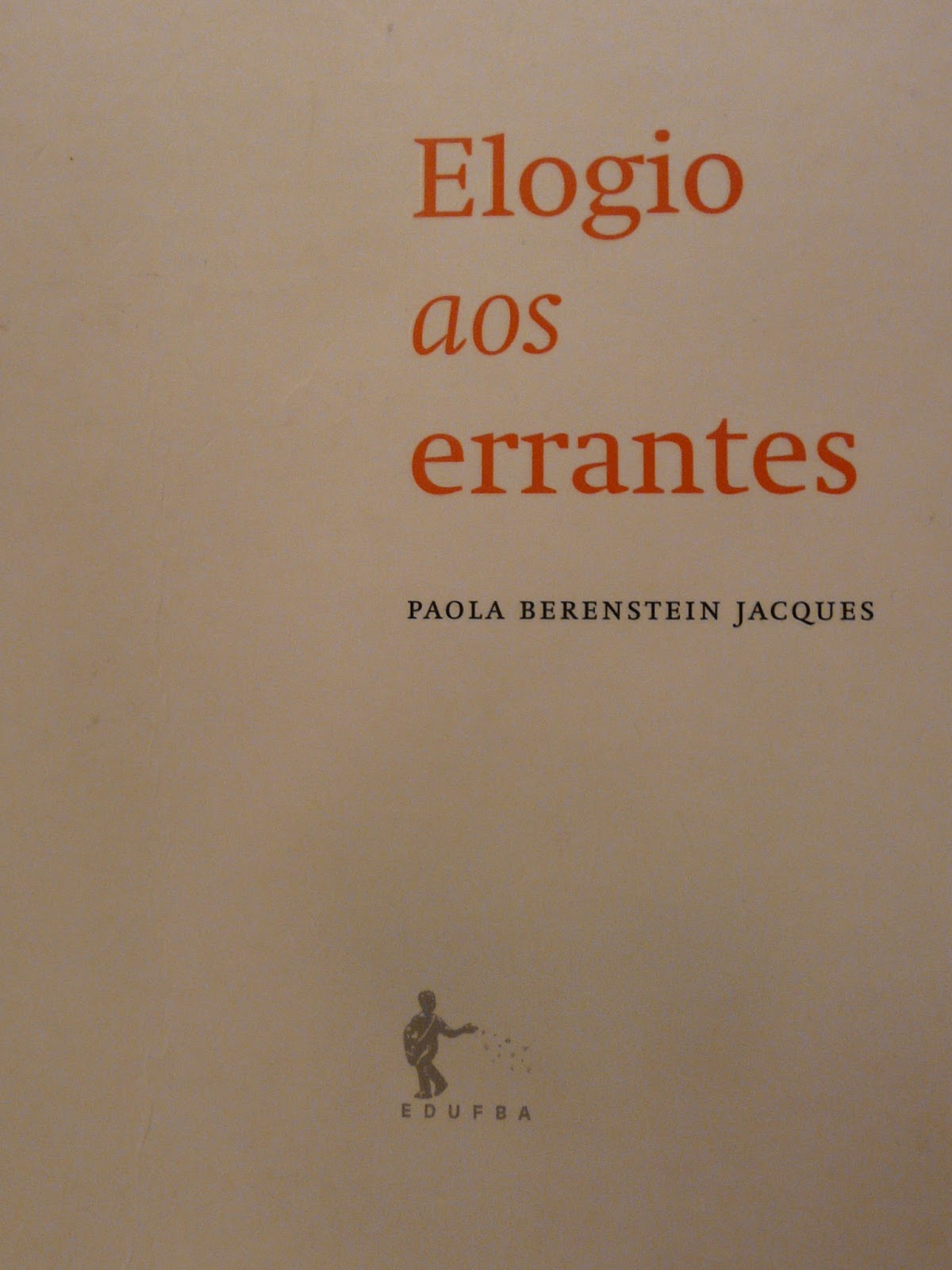
Elogio aos errantes - Paola Berenstein Jacques
Mais livros e artigos que são referencias e, assim, influencia o nosso trabalho e pesquisa para o projeto Labirinto Urbano.
Elogio aos errantes
Paola Berenstein Jacques
Elogio aos errantes pretender ser um elogio da valorização de um tipo de experiência cada vez mais rara nas cidades contemporâneas: a experiência urbana da alteridade. As práticas da errância urbana - ou seja, as experiências erráticas da cidade realizadas pelos errantes citados neste livro - são pensadas como possibilidades de experiências da alteridade urbana.
Contrapondo-se a todos os discursos que demonstram destruição ou, até mesmo, expropriação da experiência na cidade contemporânea, este livro pretende afirmar sua sobrevivência, apontando parauma possibilidade de urbanismo mais incorpordo.
Paola Berenstein Jacques é professora da Faculdade de Arquitetura e do Programa de Pós-Graduação em Arquitetura e Urbanismo da Universidade Federal da Bahia. Pesquisadora CNPq, coordena o grupo de pesquisa Laboratório Urbano.
É autora dos livros: Les favelas de Rio (Paris, l'Harmatten, 2001); Estética da ginga (Rio de Janeiro, Casa da Palavra, 2001); Esthétique des favelas (Paris, i'Harmattan, 2003); co-autora de Maré, vida na favela (Rio de Janeiro, Casa da Palavra, 2002);
organizadora de Apologia da deriva (Rio de Janeiro, Casa da Palavra, 2003), Corps et décors urbains (Paris, i'Harmattan, 2006), Corpos e cenários urbanos (Salvador, EDUFBA, 2006) e CORPOCIDADE: debates, ações e articulaçãoes (Salvador, EDUFBA, 2010).
Um Livro que faz corpo matéria do urbanismo e do urbanismo materia ética de constituição da esfera política da vida: que entende a cidade como modus de feição da vida pública: que focaliza a errância por suas narrativas e reconhece nelas a experiência de alteridade.
Quando o corpo deixa de ser escala de referência para construção de cidade e se impõe como condição da experiência para apreensão da alteridade na cidade, um rebuliço irreversível se instaura nos parâmetros estáveis e impõe a processualidade como pressuposto para o urbanismo incorporado defendido pela autora.
Fabiana Dultra Britto
Programa de Pós-Graduação em Dança - UFBA
Ver também o artigo- Corpografias Urbanas - Paola Berenstein Jacques, este artigo tem tido um grande impacto no nosso trabalho e métodos.
5.5.13
Oficina Labirinto Urbano Barra Mansa - março de 2013
Narrativa cartográfica
Deriva Mapacorpo
Deriva Mapacorpo
Narrar uma história traçar um fio que te leva e tece até onde a vista não mais alcança
Eu preciso alimentar as minhas células
Eterno retro alimentar. O que me move são os meus pés
Viviane Saar
Guardo cheiro como quem guardo dinheiro.
Uma metade do caminho que também pode ser inteiro
Lucas Cucaze
Coração Violeta.
Querer sair , tá indo pela estrada
Anderson Alves
Minha garganta reverbera meus pensamentos .
A garganta do pombo é muito estravagante
Victor Hugo Alves
Só vou gastar energia para beijar sua boca
Albinno Oliveira
Oficina Labirinto Urbano no Rio de Janeiro - março de 2013
Deriva narrativa - MapaCorpoCidade
Memória afetiva dos participantes sobre suas experiências no exercício - MapaCorpo
CIDADE POLIFONICA
3.4.13
The wheels on the bus...........
Assinar:
Postagens (Atom)